

Cannabis production needs careful environmental management to reliably generate high-quality crops throughout the year. We recently posted an article regarding positive pressure (semi-closed) greenhouses, and using pad and fan (adiabatic cooling) as a cooling method. In certain situations, and in order to guarantee a specific climate set points around the plants all year round, clients require a complete closed greenhouse, and with that, mechanical cooling.
Mechanical cooling becomes a crucial option for greenhouse situations when environmental factors, such as high humidity levels, make the use of adiabatic cooling alternatives impractical. It's vital to remember that compared to adiabatic cooling technologies, mechanical cooling often has greater initial investment (CAPEX) and ongoing operational expenses (OPEX).
Through a series of ducts, the cooled air is consistently circulated throughout the greenhouse to ensure effective circulation. Mechanical cooling is incredibly adaptable; in addition to controlling temperature, it also controls and removes humidity from the greenhouse.
Mechanical cooling technology that is used in closed greenhouses includes:
Chillers
In closed greenhouses, chillers are a cutting-edge mechanical cooling technique. Chillers produce cold air with remarkable efficiency by using an electrically powered compressor. A critical efficiency measure known as the coefficient of performance (CoP) typically has a value of 5. This means that 5 kWh of cold air may be produced using just 1 kWh of power. Chillers are a dependable option for precise climate management since they are excellent at creating air with much lower temperatures.
Heat Pumps
Heat pumps, which function like an "inverted refrigerator," are a tremendous advancement in closed-loop greenhouse cooling technology. Heat pumps provide a variety of heat-generating choices by transferring heat through a compressor, evaporator, and a liquid-gas refrigerant circuit. The CoP is an important efficiency indicator; for example, a CoP of 4 means that 1 kWh of electrical energy produces 4 kWh of heat. Energy carrier properties and the needed output water temperature are two factors that have an impact on this efficiency factor. Heat pumps are frequently used in horticultural installations along with thermal storage from subsurface aquifers.
Absorption Chillers
Absorption chillers use leftover heat from sources like steam, hot water or hot gas to introduce a novel method of chilling. Absorption chillers, in contrast to traditional heat pumps, use two different media: an absorbent (commonly lithium bromide) and a refrigerant, which is often water. Once more, the CoP is used as a yardstick for efficiency; a CoP of 1 denotes the production of 1 kWh of cold while using the same amount of heat.
Single effect, double effect, and the most recent development, triple effect, are the several types of absorption chillers. A single generator distinguishes single-effect systems, which display a CoP value below 1.0. With CoP values above 1.0, double effect systems—which use two generators and condensers—boast superior efficiency. Triple effect systems, which have a third generator and condenser and have CoP values greater than 1.5, are the epitome of efficiency. In order to improve performance, absorption chillers are frequently combined with high-grade industrial waste heat in horticulture.
ClimaPora
We offer various closed greenhouse designs, each of which is adapted to the requirements of our customers. One of our ground-breaking creations, the ClimaPora, guarantees an ideal climate inside a closed greenhouse environment. This can be ideal for cannabis cultivation, where plants release a lot of water by evapotranspiration. Exceeding the acceptable moisture level over a period of a few hours may be the single trigger for fungal diseases.
The complex climate chamber at the center of the ClimaPora design was painstakingly designed to control temperature, offer heating capabilities, and efficiently dehumidify the air. The outcome? A carefully regulated atmosphere of unsurpassed excellence.
ClimaPora's creativity goes even further thanks to a thoughtfully planned distribution structure. Imagine the ideal air being purified and adjusted as it flows beautifully via specialised pipes that are covertly tucked beneath the growth systems. This tactical strategy ensures that every plant benefits from the optimal climate conditions required for its growth.
Watch the video below to see how effective this idea is put into practice.
Within the ClimaPora greenhouse, air undergoes simultaneous heating and dehumidification processes within a single climate chamber.
The air encounters a transformational experience as it moves within the chamber. With the gentle support of cutting-edge heating systems, the temperature starts to slowly rise. In addition, the air's moisture content is expertly drained, lowering humidity levels and promoting an environment that is perfect for plant culture.
An essential part of managing a cannabis greenhouse is air filtration. Contaminants, pests, or illnesses that could damage cannabis crops and lower their quality could be carried by incoming air. Ensuring that the greenhouse atmosphere is free from potential hazards requires the implementation of appropriate air filtering technologies.
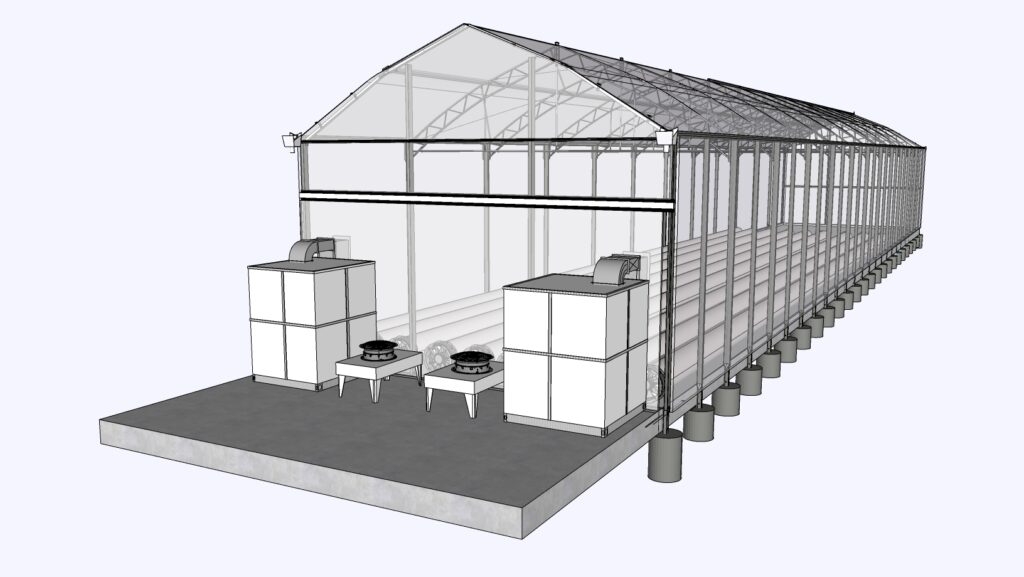
An alternative solution is easily accessible when circumstances preclude the installation of a separate climate chamber due to space restrictions or capacity limitations. In the most recent technical advancement, chillers and air handling units are seamlessly integrated into expansion units that can be easily and quickly integrated into the greenhouse construction in a modular form. The system combines cooling, heating and dehumidification by using the integrated units.
This strategy ensures a workable and effective solution for your greenhouse needs by streamlining the design and construction processes.
Cannabis producers can benefit from Bosman Van Zaal's expertise and 90 years of greenhouse engineering experience by achieving maximum yields, potency, and quality while adhering to sustainable standards. In the rapidly expanding cannabis market, growers may take their operations to new heights of success by concentrating on accurate climate management and effective greenhouse construction.
For more information about how a closed greenhouse system can benefit your agriculture operations, contact us at info@bosmanvanzaal.co.za or 072 576 2626
Bosman Van Zaal has 90 years of experience in the development and construction of greenhouses and over 40 years' experience with technical systems for international horticulture.

Receive thought leadership articles on protected horticulture and the commercial greenhouse industry in South Africa.